

Choose an entry point
Start in chat
Describe the trading idea in plain language. Include the market and instrument, the signal, position size, holding rule, and whether you want a backtest. Qube can generate market-specific code and save the first version.Start in the Strategy Library
Open the Strategy Library, choose + HK strategy or + US strategy, then edit the description, code, and backtest parameters on the detail page. Saving creates a version when the code or saved parameters change.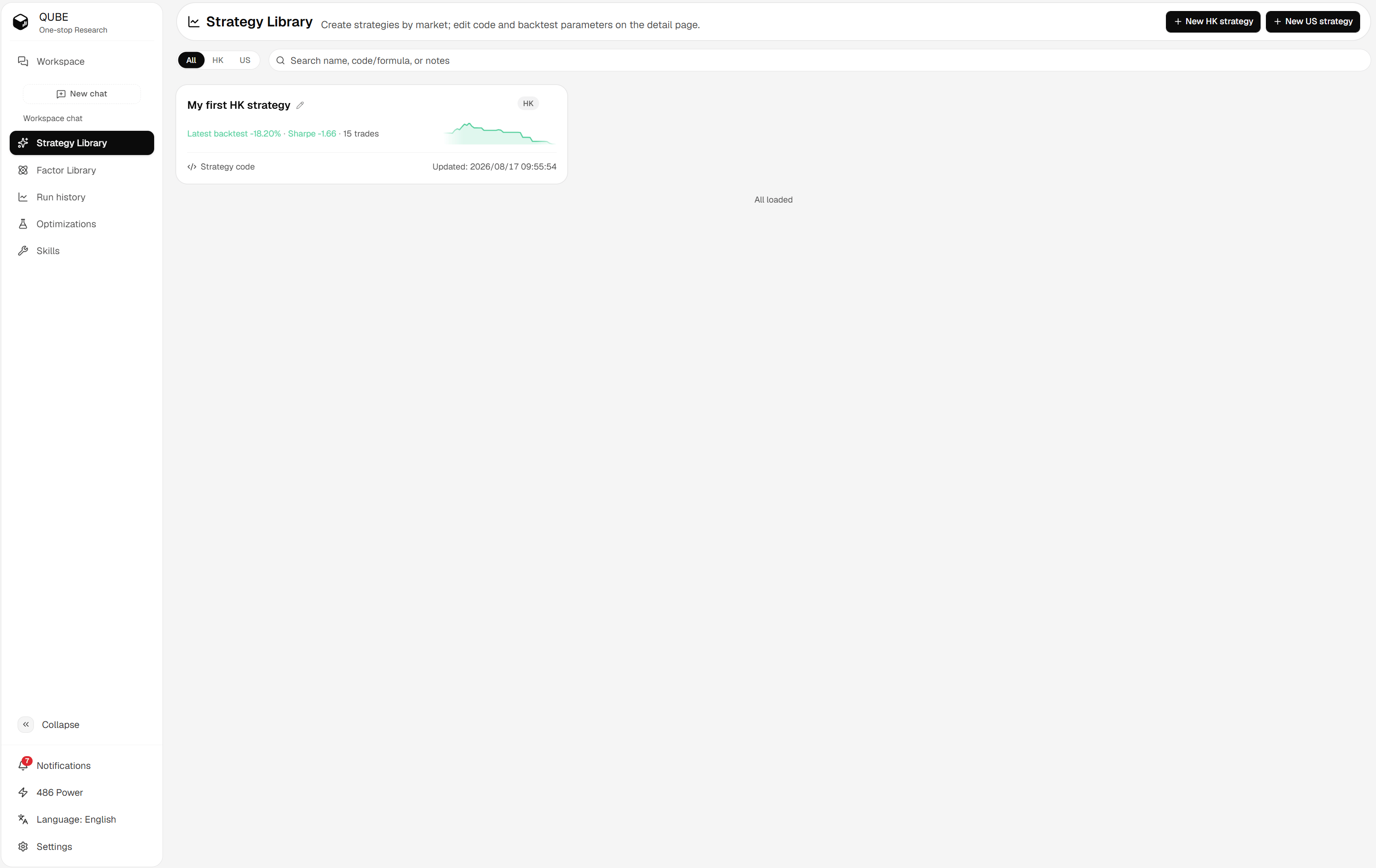
Strategy Library with market filters, search, and new strategy actions
Start from a factor
From a factor analysis, ask Qube to turn the factor into a strategy. Qube first shows a proposal with the market and selection parameters. Confirm the proposal before the strategy is created. See Turn a factor into a strategy.Create and review
1
Describe the trading logic
State what creates an entry, what creates an exit, how much to hold, and what should happen when data or liquidity is unavailable.
2
Check the generated strategy
Confirm the symbol format, market data source, frequency, order functions, and risk rules. Make sure the code does not use future data.
3
Save the version
Save after reviewing both code and backtest parameters. Qube records the code and parameters together so you can reproduce the run.
4
Run a backtest when ready
Use the saved version as the source for the run. Read the metrics, equity curve, trades, and log before changing the strategy.